Dog Symptoms: When to Call Your Veterinarian
Call your veterinarian when a change in eating, drinking, energy, movement, breathing, toilet habits, skin or behavior lasts, gets worse, or worries you. Describe what you see, how often, for how long and when it started, and let the clinic decide how soon your dog needs to be seen. This checklist helps you record those details before you call.
When something looks off, the useful question isn't 'what does my dog have?' — it's 'does this need a professional?' This guide is about that decision: which changes are worth describing to your clinic, how to write them down so the description is actually usable, and how to report them so the people who can examine your dog are the ones deciding what happens next.
It deliberately doesn't tell you what your dog has, and it isn't a symptom checker. Two dogs with the same sign can be in completely different situations, some harmless things look alarming and some serious ones look mild, and no page can see your dog. A diagnosis needs an examination, your history, and whatever tests your veterinarian chooses — anything that skips those steps is guessing from averages.
So this is the other half of the job: the observing, recording and reporting. Do it well and you get faster answers, fewer repeat visits, and a clinic that can act on what you're telling them instead of working backwards from a vague 'he's not himself'.
Free PDF · No email required
Dog Symptom & Vet Visit Checklist
Write down what changed, when and how often before you call the vet.
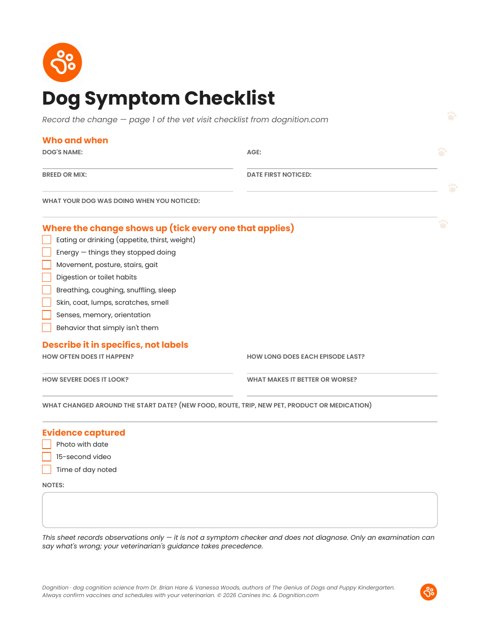
Dog Symptom Checklist
Saved only in this browser. Nothing you type is sent to Dognition.
Who and when
Where the change shows up (tick every one that applies)
Describe it in specifics, not labels
Evidence captured
This sheet records observations only — it is not a symptom checker and does not diagnose. Only an examination can say what's wrong; your veterinarian's guidance takes precedence.
Prepare for the Call & the Visit
What to say, what to ask, what to bring — page 2 of the vet visit checklist from dognition.com
Say this on the phone (let the clinic judge how soon your dog needs to be seen)
Questions to ask (write them down — they're easy to forget in the room)
Bring to the appointment
After the visit — keep the record going
One place for the whole history
Keep every record, visit and medication in the Dognition app (CanineQ) health section — the whole history on your phone in the waiting room. Prefer paper? Pair this sheet with the free vaccination record template at dognition.com/dog-vaccination-record-template.
This sheet records observations only — it is not a symptom checker and does not diagnose. Only an examination can say what's wrong; your veterinarian's guidance takes precedence.
Changes usually worth describing to your clinic
None of these is a verdict, and none of them is a diagnosis — they're reasons to call and say what you're seeing. The team at your clinic decides how soon your dog needs to be seen; your job is the observation.
Eating and drinking
A missed meal happens. A change in appetite or water intake that holds for more than a day or two, refusing food altogether, or drinking noticeably more than usual is worth describing — especially alongside any weight change you can see or feel on the ribs.
Energy, and the things they stopped doing
Less eager on the walk, not meeting you at the door, giving up the jump onto the sofa. Cornell's guidance on recognizing pain points out that owners are usually the first to spot these quiet withdrawals, because dogs don't tell us where it hurts — they just stop doing things.
Movement and posture
Stiffness after a rest, hesitating at stairs or in the car, an unsteady or wobbly gait, sitting differently, or favoring a limb. Changes in how a dog moves are among the most visible signs that something isn't right, and among the easiest to film.
Digestion and toilet habits
Vomiting, loose or unusually pale stool, straining, accidents in a house-trained dog, or a change in how often they go out. Cornell's guidance on vomiting treats ongoing or repeated vomiting as something to bring to your vet rather than wait out, and notes that even infrequent but regular vomiting can be a signal.
Breathing, coughing and sleep
A new cough, noisy or harder breathing at rest, snuffling, or a change in how your dog sleeps — pacing, unable to settle, up in the night. These are worth describing whenever they're new, and worth describing promptly in an older dog.
Skin, coat, lumps and smell
A coat going dull or greasy, a lump that's new or growing, a scratch or hot spot that isn't healing, darkening or thickened skin, or a new odor from the skin, ears, mouth or breath. These are easy to photograph and easy for a veterinarian to interpret — bring the pictures.
Senses, memory and orientation
Not responding to their name, bumping into doorframes, staring at a wall, hesitating on a familiar walk, or seeming unsure where they are. In an older dog these changes deserve a conversation about cognitive aging rather than being written off as the years.
Behavior that simply isn't them
Restlessness, clinginess, irritability, a confident dog suddenly avoiding you, or a quiet dog pacing and seeking you out. Behavior change is often the first visible sign of a physical problem, which is why clinics ask about it — bring it up even when it feels like the least important detail.
What to do when you notice a change
Six steps from 'something's odd' to an appointment where the veterinarian already has the picture. Most of the work is writing things down.
- 1
Write down when it started and what was different
Note the date you first noticed it and what your dog was doing when you did. 'Third evening after we came back from the beach, on the sofa, mid-chew' is worth more than 'recently' — onset and context are the first things your veterinarian will ask about.
- 2
Describe it in specifics, not labels
How often does it happen, how long does each episode last, how severe does it look, and does anything make it better or worse? Then list what changed around that date: a new food, a new walking route, a trip, a new pet, a product or medication started. Resist the urge to name the condition — that's the part only an exam can do.
- 3
Record it while it's happening
A fifteen-second video or a photo with a date beats the best written description, because your veterinarian sees the real thing: how the body moves, how the breathing sounds, how the ear actually looks. Note the time of day — patterns across days are often the most useful clue.
- 4
Call and describe, then let the clinic judge
Phone or message your clinic with the specifics you've written down and ask how soon they want to see your dog. Deciding how urgent something is belongs to them, not to you and not to a search engine — you're supplying the observations, they're supplying the triage. If you can't reach your clinic, ask whether they run an after-hours service or can recommend one.
- 5
Bring the record and a short list of questions
Take the notes, the photos and the current medication list to the appointment, along with your questions written down — they're easy to forget in the room. Ask what the exam will involve, what the results will and won't tell you, and what you should watch for between visits.
- 6
Keep the record going after the visit
Once the appointment is done, store the outcome, the medications and the next check-in date in the same place you keep your notes. The next time something looks off, you'll have a baseline to compare against instead of a drawer of receipts.
Why your dog's personality belongs in the history
'Symptom' is a comparison. Lying still can be contentment in one dog and distress in another, and the only baseline that matters is your dog's. Brian Hare and Vanessa Woods's research at the Duke Canine Cognition Center is built on that fact: dogs are individuals with distinct cognitive styles, so the way a dog handles frustration, seeks help from a person, or responds to something unfamiliar varies from animal to animal — and a change in any of those habits is information.
That's why the Dognition assessment is worth doing while your dog is well: it gives you a documented picture of how your dog thinks and communicates — how readily they look to you for help, how they approach a new problem, how much they bother about it. When something does change, you're not saying 'she's off'; you're saying 'the dog who normally brings me the lead and solves things is now sitting by the door and not reacting'. That's the description a veterinarian can work with, and it's the reason we pair the assessment with a health record that keeps visits and medications in one place.
The vet visit checklist
The six steps above, turned into two printable pages. Page one records the change while it's happening — who and when, which parts of your dog it touches, the specifics, and what changed around the start date. Page two prepares the phone call and the appointment: what to say, the questions to write down, what to bring, and what to note after the visit.
It's a record-keeping sheet, not a symptom checker — nothing on it tells you what your dog has. It exists so the story you tell your veterinarian is specific, dated and complete.
Keep the record in one place
Most of what a veterinarian needs isn't a symptom — it's a history. What you noticed and when, what your dog is taking, what the last visit concluded, what was already ruled out. That's also the part that lives in a drawer, an inbox thread, or a memory that fails you in the exam room.
The Dognition app, CanineQ, includes a complete health section for exactly this: your dog's vet records and documents, every visit, and their medications and reminders, all stored together so you can bring the whole picture up on your phone — and hand it over rather than reconstruct it.
It stores what you enter. It doesn't interpret it: no diagnoses, no guess about what your dog 'probably has', no substitute for an examination. Reading your dog's history and deciding what it means is your veterinarian's job, and it stays theirs.
Where this comes from
The framing above draws on owner-facing guidance from veterinary institutions rather than a single opinion:
- Cornell Riney Canine Health Center — Recognizing pain in dogs — why owners are best placed to spot the subtle changes, and what those changes tend to look like.
- Cornell Riney Canine Health Center — Vomiting — why ongoing or repeated vomiting is a veterinary conversation rather than something to wait out.
- Cornell Riney Canine Health Center — canine health information — topic-by-topic owner guidance for specific signs.
- American Veterinary Medical Association — Caring for senior cats and dogs — why older dogs need more frequent checkups (the AVMA suggests twice a year), and why routine exams are how subtle changes get caught early instead of explained away as the years.
General educational information, written for owners and checked against those sources — not advice about your dog. Your veterinarian knows your dog's history and examination findings, so their guidance takes precedence over anything on this page.
Related reading
- Canine Health: The Whole-Dog GuideThe pillar page this guide sits under: body, mind and behavior across a dog's life, and what to watch at each stage.Read the guide
- When to Worry About Your Dog's BarkingThe same when-to-call-the-vet thinking applied to vocalization and body language, with a record sheet built for it.Read the guide
- Signs of Aging in DogsWhich changes in an older dog are expected and which ones you should describe to your veterinarian.Read the guide
- Dog Vaccination Record TemplateA free printable page for the documents and dates you'll want in the exam room.Read the guide
Where owners get stuck
“I don't want to waste the vet's time over nothing.”
Describing something that turns out to be nothing is not a waste of their time — it's the ordinary work of a clinic, and it usually takes a couple of minutes. You're asking them to make the urgency judgment, which is their job. If it happens repeatedly, ask whether a routine check-in appointment would give you both more to look at.
“The exam found nothing, but I still know something's off.”
Say exactly that. Ask what they'd want you to watch for, what would change the picture, and when to come back — then keep recording, because some things only look like a pattern over weeks. A second opinion or a referral to a specialist is a reasonable next step, not an insult to the first veterinarian.
“I can't remember when it started.”
This is the most common gap in a health history, and it's fixable from today: date your notes the day you notice them, keep photos with their timestamps, and store visits and medications somewhere you'll actually open. The health section in the Dognition app does this; the printable record template does the paper version.
“I looked the symptom up and now I'm convinced it's serious.”
That's the predictable effect of reading a list of conditions next to a single sign — the most frightening match sticks. Bring your observations to your clinic instead of your conclusion. The observations are useful; the conclusion has to be earned by an exam.
Questions owners ask about dog symptoms and the vet
- Is there a reliable dog symptom checker?
- Not one that can tell you what your dog has. Any tool that turns a list of signs into a condition is reasoning from averages — it has never met your dog, doesn't know their baseline, age, history or what they ate, and can't examine them. Symptom checkers also tend to surface the most dramatic condition that fits, which is a fast route to panic. What actually works is a specific record and a conversation with your clinic, which is what this guide is for.
- How do I know whether it's urgent?
- You don't have to work that out alone — it's the judgment your clinic is trained for. Describe what you've noticed, how fast it changed, and whether your dog is eating, drinking and behaving normally, then ask how soon they want to see them. If your own clinic is closed, ask them whether they have an after-hours service or a preferred emergency clinic, rather than guessing from a website.
- Can I just wait and see?
- For a bright, eating, apparently normal dog with one odd hour, waiting is often reasonable — but make it a decision rather than a drift. Describe what you saw to your clinic and ask what they'd want you to watch for and for how long. Waiting without telling anyone is how patterns get missed and how a history becomes 'it's been going on for weeks, I think'.
- What should I tell them on the phone?
- Six things: when it started, how often it happens, how long each episode lasts, what makes it better or worse, whether your dog is eating and drinking normally, and anything that changed around the start date (food, activity, travel, a new product, a medication or supplement). Add your dog's age, breed or mix, and any known conditions. That short list changes what the clinic recommends.
- Should I give my dog something for it?
- Not without your veterinarian's say-so. Several common human medicines are unsafe for dogs, and a dose that's sensible for one dog is not for another of different size, age or health. Giving anything before the exam can also mask the exact signs your veterinarian needs to see. Ask them instead — it takes a phone call.
- Where should I keep vet records, visits and medications?
- In one place you can actually find. The Dognition app (CanineQ) has a complete health section for your dog's vet records, visits and medications, so the whole history is on your phone in the waiting room. If you prefer paper or a spreadsheet, the free vaccination record template and the printable vet summary do a similar job.
- Do older dogs show illness differently?
- Often more quietly. The veterinary guidance on senior dogs is full of changes that read as 'just getting old' — a slower start on cold mornings, a bad night, less interest in dinner, a little less enthusiasm at the door. That's exactly why age-related change is worth describing early: your veterinarian can tell you what's expected for your dog and what deserves a workup, rather than everyone assuming it's the years.