Free Printable Bark, Body & Context Worksheet
A bark, body and context worksheet helps you read your dog's barking the way researchers do: by looking at the sound, your dog's body language and the situation together, then comparing them with your dog's normal. It records what you saw, not a diagnosis, so you can share clear facts with your vet or trainer.
A companion to the five worked examples in our article What Your Dog's Bark Is Telling You. Note your dog's baseline, then write down what you heard and saw in real moments.
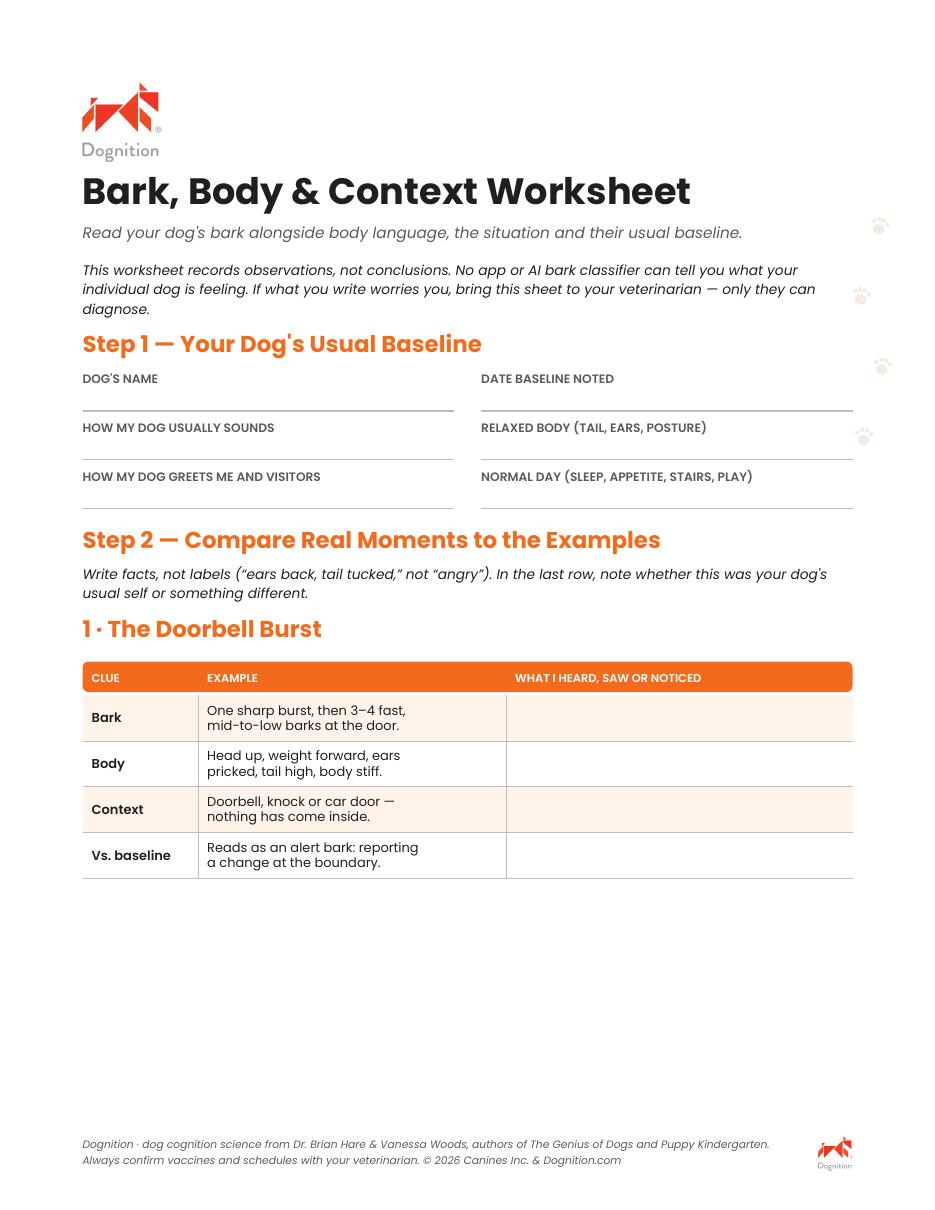
What's on the printable
- Your dog's usual baseline: sound, body, greetings and a normal day
- Five worked examples: bark, body, context and vs. baseline
- Space to write what you heard, saw and noticed
- A notes box for questions for your vet or trainer
The five examples
- The doorbell burst — usually an alert bark about a change at the boundary.
- The bark that starts the second you leave — can point to distress; film it and talk to your vet.
- The high, spaced-out bark from the couch — usually a request; the pause-and-look is the tell.
- The bark when you touch a hip or take the stairs — a possible pain signal; book a vet visit.
- The 3 a.m. bark from an older dog — worth a conversation with your vet.
To record every episode over time, use The Bark Log. For warning signs, see when to worry about your dog's barking.
Fill out online & print
Bark, Body & Context Worksheet
Saved only in this browser. Nothing you type is sent to Dognition.
This worksheet records observations, not conclusions. No app or AI bark classifier can tell you what your individual dog is feeling. If what you write worries you, bring this sheet to your veterinarian — only they can diagnose.
Step 1 — Your Dog's Usual Baseline
Step 2 — Compare Real Moments to the Examples
Write facts, not labels (“ears back, tail tucked,” not “angry”). In the last row, note whether this was your dog's usual self or something different.
1 · The Doorbell Burst
| Clue | Example | What I heard, saw or noticed |
|---|---|---|
| Bark | One sharp burst, then 3–4 fast, mid-to-low barks at the door. | |
| Body | Head up, weight forward, ears pricked, tail high, body stiff. | |
| Context | Doorbell, knock or car door — nothing has come inside. | |
| Vs. baseline | Reads as an alert bark: reporting a change at the boundary. |
2 · The Bark That Starts the Second You Leave
| Clue | Example | What I heard, saw or noticed |
|---|---|---|
| Bark | Starts within a minute of the door closing; repetitive, may howl. | |
| Body | Pacing, drooling, scratching at the door, tail down, ignores a puzzle. | |
| Context | You have gone; a camera shows it started as you put on your shoes. | |
| Vs. baseline | Points to distress, not mischief — film it and talk to your vet. |
3 · The High, Spaced-Out Bark From the Couch
| Clue | Example | What I heard, saw or noticed |
|---|---|---|
| Bark | Short, higher barks with gaps, each followed by a glance at you. | |
| Body | Loose and wiggly, tail sweeping, mouth open, maybe a play bow. | |
| Context | You are sitting still; leash or toy in view, or dinner is late. | |
| Vs. baseline | Reads as a request, not a warning — the pause-and-look is the tell. |
4 · The Bark When You Touch a Hip or Take the Stairs
| Clue | Example | What I heard, saw or noticed |
|---|---|---|
| Bark | A sudden yelp or low growl-bark, seemingly out of nowhere. | |
| Body | Stiffening, flinching, lip licking, whale eye, avoids stairs or jumps. | |
| Context | Nothing frightening happened — it came with movement or touch. | |
| Vs. baseline | Possible pain signal, not disobedience — book a vet visit. |
5 · The 3 a.m. Bark From an Older Dog
| Clue | Example | What I heard, saw or noticed |
|---|---|---|
| Bark | Monotonous, low, seemingly purposeless — the same sound. | |
| Body | Wandering, staring at a wall, hesitant on stairs, slow to name. | |
| Context | At night, in a dog who has never been a night barker. | |
| Vs. baseline | Worth a conversation with your vet rather than a training trick. |
Bringing It Together
If several rows differ from usual — especially examples 2, 4 or 5 — book a veterinary visit and bring this sheet plus your Bark Log. If everything matches baseline, you've documented your dog's normal, which makes future changes easy to spot.
Sources: Kaunas University of Technology bark-classification research (Prof. Rytis Maskeliūnas), via Newsweek, Sep 30, 2026 · Hare & Woods, The Genius of Dogs (Dutton, 2013).
Log every bark episode: The Bark Log — dognition.com/bark-log
Frequently asked questions
- How do I tell what my dog's bark means?
- Look at three things together: the sound, what your dog's body is doing, and what is happening around them. Then compare it with your dog's usual baseline. The same bark can mean different things, and the body and the situation usually break the tie.
- Can this worksheet tell me what my dog is feeling?
- No. It helps you record observations, not conclusions. No app or AI bark classifier can reliably read an individual dog. If what you write down worries you, bring the sheet to your veterinarian.
- What's the difference between this and the Bark Log?
- The Bark Log records every bark episode over time. This worksheet compares a few real moments with five worked examples and your dog's normal, so you can spot what's different.
- Is the worksheet free and fillable?
- Yes. It's a free fillable PDF with no email or account required. You can also fill it out online and print it, and nothing you type is stored on our servers.