The Bark Log
A bark log is a record of each barking episode: when it happened, what was going on, what the bark sounded like, your dog's body language and the likely trigger. Owners use it to spot patterns and to give a veterinarian or trainer facts instead of a general description. It records what you observe; it does not diagnose.
Log each bark as it happens — what was going on, how it sounded, what your dog's body was doing, and what happened next. After a few days, print it or download it to share with your veterinarian or trainer.
Not a diagnosis: this log organizes what you observe. An app calling a bark “angry” or “lonely” is a sound-pattern match from other dogs — only your veterinarian can diagnose.
Observations recorded by the owner. This log does not diagnose — please review with your veterinarian.
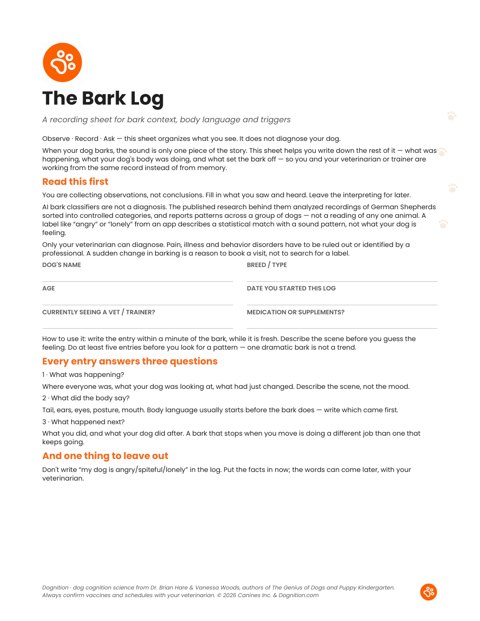
What's on the printable
- Dog details and medication or supplements
- Nine bark entries with context and body language
- Body language and trigger checklists
- Bark descriptors
- Weekly pattern review
- When to bring in a professional and sources
Your ongoing digital Bark Log
For next steps, see how to train a dog to stop barking, separation anxiety in dogs, and when barking changes warrant a call to your vet.
Fill out online & print
The Bark Log
Saved only in this browser. Nothing you type is sent to Dognition.
Observe · Record · Ask — this sheet organizes what you see. It does not diagnose your dog.
When your dog barks, the sound is only one piece of the story. This sheet helps you write down the rest of it — what was happening, what your dog's body was doing, and what set the bark off — so you and your veterinarian or trainer are working from the same record instead of from memory.
Read this first
You are collecting observations, not conclusions. Fill in what you saw and heard. Leave the interpreting for later.
AI bark classifiers are not a diagnosis. The published research behind them analyzed recordings of German Shepherds sorted into controlled categories, and reports patterns across a group of dogs — not a reading of any one animal. A label like “angry” or “lonely” from an app describes a statistical match with a sound pattern, not what your dog is feeling.
Only your veterinarian can diagnose. Pain, illness and behavior disorders have to be ruled out or identified by a professional. A sudden change in barking is a reason to book a visit, not to search for a label.
How to use it: write the entry within a minute of the bark, while it is fresh. Describe the scene before you guess the feeling. Do at least five entries before you look for a pattern — one dramatic bark is not a trend.
Every entry answers three questions
1 · What was happening?
Where everyone was, what your dog was looking at, what had just changed. Describe the scene, not the mood.
2 · What did the body say?
Tail, ears, eyes, posture, mouth. Body language usually starts before the bark does — write which came first.
3 · What happened next?
What you did, and what your dog did after. A bark that stops when you move is doing a different job than one that keeps going.
And one thing to leave out
Don't write “my dog is angry/spiteful/lonely” in the log. Put the facts in now; the words can come later, with your veterinarian.
Bark entries
One row per bark. Short notes are fine — “kitchen, mail slot clicked, tail up, 3 barks, I said ‘quiet’, she stopped” is a complete entry.
| Date & time | What was happening (context) | Bark (pitch · pace · length) | Body language (tail, ears, eyes, posture) | Trigger you saw | What you did & what happened |
|---|---|---|---|---|---|
Tick what you actually saw, not what you expected to see. If two boxes fit, tick both — mixed signals are normal and worth writing down.
Body language quick check
Bark descriptors
| Pitch | high · mid · low · broken |
|---|---|
| Pace | single · slow · repetitive · rapid |
| Length | one burst · minutes · on and off |
| Onset | sudden · gradual · after a sound |
| Volume | quiet · loud · rising |
| Stopped when… | you moved · you spoke · ignored |
Common triggers — tick what you have seen
Weekly pattern review
Do this once a week, with your entries in front of you. Answer in a phrase, not a theory — the point is to hand your veterinarian or trainer something concrete.
When to bring in a professional
Bring this log to your veterinarian or a qualified trainer. The pattern across a week or two matters more than any single bark.
Book a veterinary visit promptly if barking changes suddenly, comes with pacing, drooling, accidents or restlessness, your dog seems confused or disoriented, or you suspect pain.
Get help straight away if your dog is hurting themselves, trying to escape a crate or room, or the distress is severe.
What this log cannot do
It cannot tell you why your dog barks, and it is not a diagnosis. Even a good AI classifier was trained on other dogs — often a single breed — and reports how a sound matches a pattern seen across a group. Your dog is one animal with their own history, health and home. Use the log to describe, then ask your veterinarian to interpret.
Sources
Machine-learning analysis of dog vocalizations by Professor Rytis Maskeliūnas and colleagues, Faculty of Informatics, Kaunas University of Technology (KTU), Lithuania — reported in “Your Dog's Bark Could Be Telling You Something, Study Finds” by Liz O'Connell, Newsweek, 30 September 2026.
Brian Hare and Vanessa Woods, The Genius of Dogs (Dutton, 2013), on how dogs evolved to communicate with people. Related Dognition guides: separation anxiety in dogs, how to train a dog to stop barking, and why dogs eat poop.
Frequently asked questions
- How do I figure out why my dog is barking?
- Write down what was happening, what the bark sounded like, your dog's body language and what set it off, every time. After a week or two, patterns in time, place and trigger usually show up.
- When should I call the vet about barking?
- Call if barking changes suddenly, comes with pain, confusion, restlessness at night or other changes in behavior, or you're worried. Bring the log so the clinic sees what you've seen.
- Can the Bark Log diagnose my dog?
- No. It records observations for you to discuss with your veterinarian or trainer.
- Where are my online entries saved?
- Entries stay in this browser on this device. They are not sent to Dognition.
- Is the Bark Log free?
- Yes. The fillable PDF and online forms are free, with no email required.