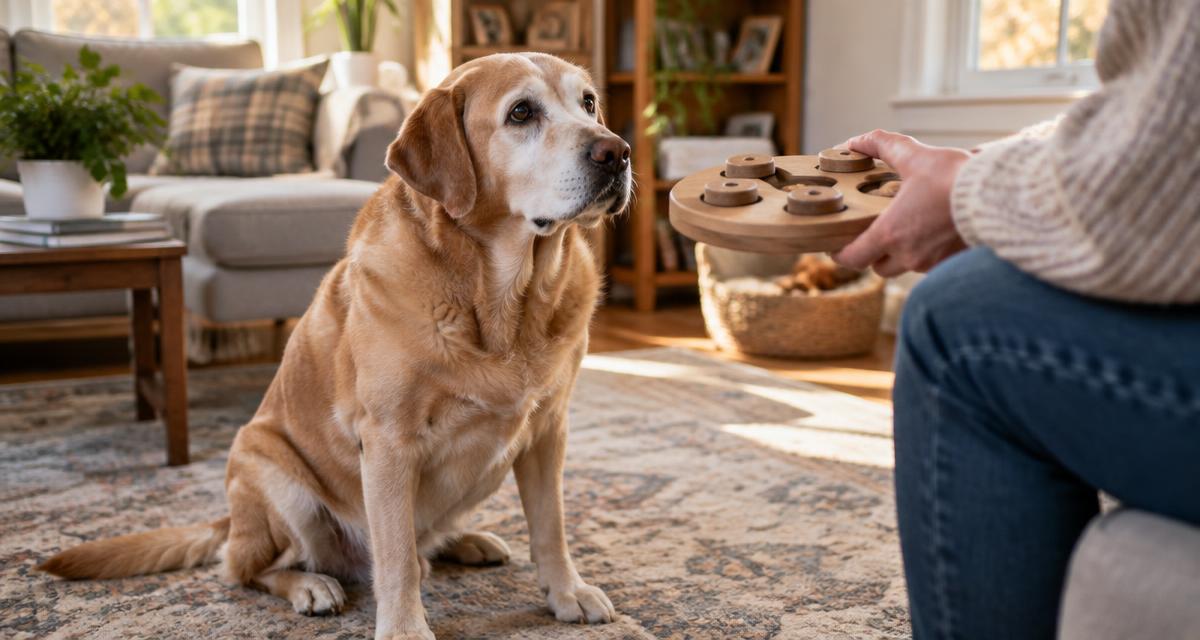
Dog cognitive aging assessment
Where is your dog on the aging curve, and is what you are seeing ordinary? Answer eight observation questions built on the DISHAA categories veterinary behaviorists use, and see your dog’s life stage alongside group averages from 25,463 Dognition assessments — plus the tracking activities that fit what you described.
Check your dog’s stage
Answer for change from how your dog used to be, not for lifelong habits. Two minutes, eight questions.
Choose an age, a size and an answer for each observation.
“An aging dog is not a diminished dog. It trades raw problem-solving for a deeper read on its people.”
Cognition across a dog's lifetime
Four cognitive dimensions plotted against age across 25,463 Dognition assessments. Each one has its own trajectory — the dog mind does not simply rise and then fall.
Sample per bin ranges from n=444 (age 12) to n=3,539 (age 3); a research sample of 25,463 dogs.
Source: Dognition assessment dataset, 25,463 dogs binned by owner-reported age. Gaze is measured in seconds (0–90); the other dimensions are proportions (0–1). Aggregated group averages, not a clinical measure of any individual dog.
Common questions
- Is this a diagnosis of dog dementia?
- No. It is an educational screener built on the DISHAA observation categories. Pain, hearing loss, vision loss and thyroid disease produce the same picture as cognitive decline, and only a veterinary exam can tell them apart.
- When does a dog become a senior?
- It depends on adult size. Giant breeds reach the senior window around six, large dogs around eight, medium dogs around ten and small dogs around eleven. The assessment uses your dog's size to place them.
- What does the Dognition data add?
- Your dog's age band is compared against group averages from 25,463 assessments, so you can see what typically changes at that age — empathy rising, reasoning easing off, memory holding then falling after twelve.
- How often should I repeat it?
- Every six months for a senior dog, or any time something changes. A single result is a snapshot; repeated results are a trend, and a trend is what a veterinarian can actually act on.
Sources
- AAHA Senior Care Guidelines for Dogs and CatsDefines the senior window by expected lifespan and size, and recommends routine cognitive screening at senior visits.
- Landsberg et al., DISHAA cognitive dysfunction evaluation toolThe six observation categories — disorientation, interaction, sleep-wake, house soiling, activity, anxiety — used by veterinary behaviorists.
- Dog Aging Project — canine cognitive dysfunction researchPopulation research linking age, activity and cognitive dysfunction risk in companion dogs.
- Dognition assessment dataset — 25,463 dogs across fourteen age bands.Aggregated group averages. Confirm anything health-related with your own veterinarian.
Keep reading
- Canine health: the whole-dog guide
How body, mind, and behavior fit together across a dog's life.
- Canine cognitive aging
How each cognitive dimension changes across a dog's life.
- Dog dementia signs
Canine cognitive dysfunction explained through DISHAA.
- Sundowning in dogs
Night pacing and evening confusion in senior dogs.
- Signs of aging in dogs
Physical, sensory and cognitive change — and the vet thresholds.