Senior dog activities · Evidence, not promises
Brain Games for Senior Dogs: Gentle Activities & the Evidence
Try relaxed eye-contact practice, familiar pointing games and easy sniffing activities with your older dog. Learn what enrichment research does — and does not — show about cognitive aging.
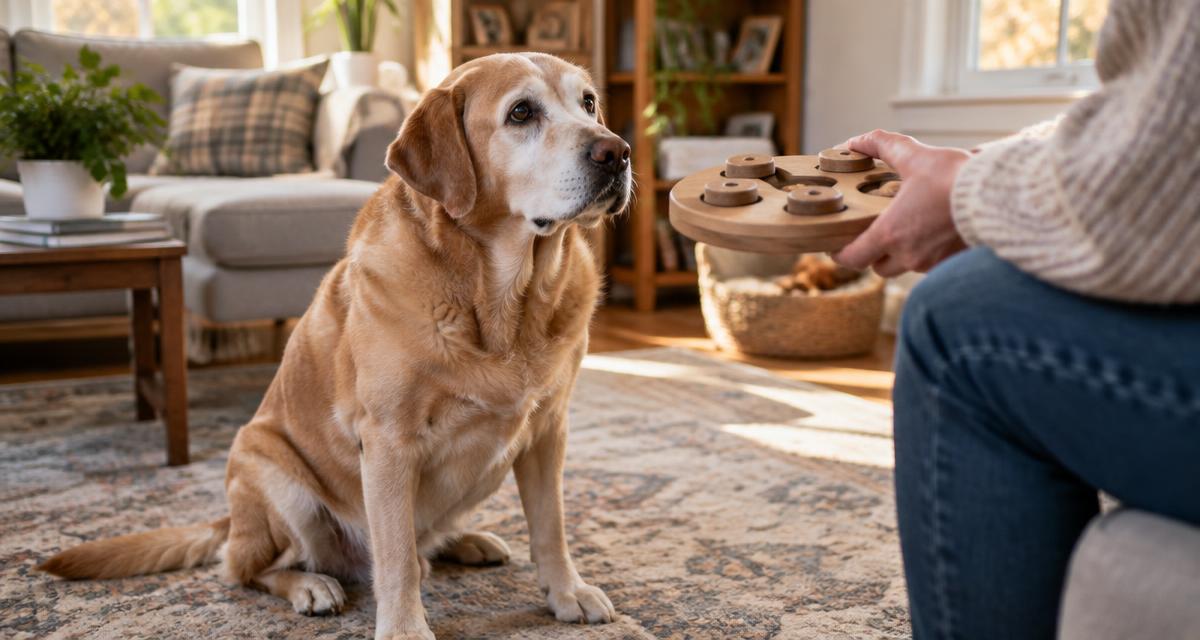
Make it enjoyable, not an exam
Dognition builds on Dr. Brian Hare and Vanessa Woods’s work at the Duke Canine Cognition Center, described in The Genius of Dogs and Puppy Kindergarten. For an older dog, the goal here is comfortable engagement with you — not a high score, a treatment or a promise to reverse decline.
Start with something your dog already enjoys. Choose a quiet, familiar place with secure footing and no need to jump or climb. Use food only if it fits your veterinarian’s feeding guidance. Stop if your dog turns away, seems uncomfortable or loses interest; do not withhold food or force participation.
What enrichment research actually shows
“Enriching experiences including playing cognitive games are believed to help brain aging in lots of species, including dogs!”
Controlled research in aged Beagles tested structured enrichment alongside antioxidant-fortified diets. Some groups performed better on particular learning tasks. Those results are encouraging, but they came from carefully controlled programs, and combined interventions complicate conclusions about enrichment alone.
Research in older pet dogs has not consistently found cognitive benefits from diet or lifelong training. None of those studies establishes that the activities below prevent dementia, slow cognitive aging or replace veterinary care. We do not recommend a diet, supplement or medical treatment from this evidence.
- Milgram et al. (2004), Neurobiology of Aging — controlled aged-Beagle enrichment and diet study; benefits on specific discrimination and reversal-learning tasks.
- Milgram et al. (2005), Neurobiology of Aging — two-year structured enrichment and dietary-fortification research in aged Beagles.
- Chapagain et al. (2020) — older pet-dog study reporting no effects of enriched diet and lifelong training on the tested behavioral and cognitive changes.
Start with gentle Eye Contact practice
Looking toward a familiar person is the behavior explored by Dognition’s Eye Contact game. For relaxed practice outside a scored assessment, reward a voluntary glance rather than asking your dog to hold a long stare.
- Sit or stand where your dog can comfortably see you. Keep your face and posture relaxed.
- Wait for your dog to choose to glance toward your face. Do not hold their head or force eye contact.
- Mark that glance with gentle praise and a suitable reward your dog enjoys.
- Pause and let your dog choose whether to engage again. Finish while the activity is still comfortable.
Practice can increase looking toward a person. That is a behavior-learning claim, not evidence of slower aging. Wallis and colleagues’ eye-contact training study found more gaze to a person’s face but less gaze-following in the test; it was not a trial of cognitive health in senior dogs.
Wallis et al. (2015): training, age and gaze following
For an actual Dognition assessment, follow the app’s instructions without adding this reward practice during scored trials. Practiced and unpracticed results are not directly equivalent.
Other familiar activities to keep easy
These are ordinary enrichment ideas, not a new Brian Hare-approved senior-game battery or a validated therapy.
A familiar pointing cue
If your dog can see the cue comfortably, point toward an obvious toy or suitable reward nearby. Keep the choice easy and avoid deliberately misleading cues. Following uncomplicated points held up in the aging study, but that does not guarantee any individual dog’s response.
An easy sniff-and-find
Let your dog watch you place a familiar toy or suitable reward in an accessible, obvious spot. Let them investigate at their own pace. Avoid tiny objects, unsafe hiding places or a puzzle they cannot reach comfortably.
A known cue, chosen by your dog
Invite a familiar behavior that does not require uncomfortable movement, such as touching your hand if that already suits them. Reward participation and accept a pause or a refusal.
See how the 4,419-dog study distinguished cognitive skills →
Keep observations — without inventing a change score
Write down the date, activity, your dog’s response, and anything different about the setting, reward or comfort. Notes about enjoyment and everyday behavior are useful context to discuss with your veterinarian. A single difficult game does not diagnose cognitive decline.
This guide does not offer automatic year-over-year assessment deltas. We also do not interpret more eye contact after practice as evidence that aging slowed. If you notice new confusion, changed sleep or a loss of familiar behavior, talk to your veterinarian rather than making the games harder.
AAHA Senior Care Guidelines — confirm appropriate activities and care with your veterinarian.
When is a dog considered a senior?
Veterinary life-stage guidelines define a senior dog as one in the last 25% of an estimated lifespan, and that estimate is set by breed and size — not by a birthday. So the same age means very different things to two different dogs.
Ages most often used for senior status, grouped by adult size.
| Size | Adult weight | Often senior at | Familiar breeds |
|---|---|---|---|
| Toy & small | Under 20 lb (9 kg) | About 8–11 years | Chihuahua, Dachshund, Pug, Toy Poodle, Yorkshire Terrier |
| Medium | 20–50 lb (9–23 kg) | About 8–10 years | Beagle, Cocker Spaniel, Border Collie, Bulldog |
| Large | 50–90 lb (23–41 kg) | About 8–9 years | Labrador Retriever, Golden Retriever, German Shepherd, Standard Poodle |
| Giant | Over 90 lb (41 kg) | About 6–7 years | Great Dane, Newfoundland, Mastiff, Irish Wolfhound |
Swipe the table sideways to see the familiar breeds in each size class.
The same birthday, two different life stages
Great Dane
May be treated as a senior at around 6 years old.
Labrador Retriever
On an average lifespan of 11–13 years, roughly senior at 8 or 9 years old.
Dachshund
May not be considered a senior until about 10 years old.
Chihuahua
At 9 years old, typically still less senior than a 9-year-old Great Dane.
These ranges come from published veterinary guidance and overlap between sources — one organization may call small breeds senior at 10–12 while another says 8–11. Treat them as a starting point. Whether your individual dog has reached their senior years, and what that means for their care, is a question for your own veterinarian.
Sources
- AAHA Canine Life Stage Guidelines — Creevy KE, et al. J Am Anim Hosp Assoc 2019;55:267–290Defines the senior stage as the last 25% of estimated lifespan, dependent on breed and size, and recommends at least twice-yearly exams for senior dogs.
- Banfield Pet Hospital — What age is a dog considered a senior?Size-based senior age bands: small under 20 lb, medium 20–50 lb, large 50–90 lb, giant over 90 lb.
- AKC — Is Your Dog a Senior Yet? Here's How to TellVeterinarian commentary on aging by breed and size, and the final-quarter-of-life-expectancy approach.
- PetMD — When Is a Dog Considered a Senior? (Morrison BJ, DVM)Size as the most accurate indicator of senior status, with small breeds around 10–12 years and large or giant breeds as early as 6–8.
- Cornell Riney Canine Health Center — Caring for Your Senior DogVeterinary guidance on senior dog care and why the seven-year rule of thumb is unreliable for individual dogs.
Frequently asked questions
- Can brain games prevent dog dementia?
- No study cited here establishes that these home activities prevent dementia or slow aging. Structured enrichment studies in aged Beagles found benefits on some learning tasks, but results do not establish a treatment for pet dogs. Confirm your dog’s needs with your veterinarian.
- Can an older dog practice eye contact?
- If your dog finds it comfortable, reward a voluntary glance toward you and keep the activity easy. Practice can encourage looking toward a person, but the cited training study did not show improved senior-dog cognition or slower aging. Do not insist on prolonged staring.
- What if my senior dog cannot see or hear well?
- Ask your veterinarian which activities suit your dog’s sensory and physical needs. A visual pointing or eye-contact task may not be appropriate. Changes in task performance can reflect sensory or physical issues rather than a change in thinking.
- Should I repeat the assessment every year?
- A routine review of dated observations can be useful, but this guide does not promise an automatic yearly assessment comparison or change delta. Ask your veterinarian what to record and how often. Practice and changing test conditions can affect task performance.
- When is a dog considered a senior?
- There is no single age. Veterinary guidelines define a senior dog as one in the last 25% of its estimated lifespan, and that estimate depends on breed and size. In practice that means small breeds (under 20 lb) are often considered senior at about 8–11 years, medium breeds (20–50 lb) at about 8–10 years, large breeds (50–90 lb) at about 8–9 years, and giant breeds (over 90 lb) as early as 6–7 years. Your own veterinarian can put a number on it for your dog, because they know the breed, body condition and health history behind the estimate.
- Why do small dogs become seniors later than large dogs?
- Size is the clearest predictor of how fast a dog ages: larger breeds have shorter average lifespans, so the final quarter of life arrives sooner. A 9-year-old Great Dane is usually much further into their senior years than a 9-year-old Chihuahua. Because small dogs live longer overall, their senior window starts later and can stretch into their early teens.
- Is a dog a senior at 7 years old?
- Seven is a useful reminder to start watching for change, not an official line. Veterinarians often use around seven years as the point to discuss twice-yearly exams and more regular bloodwork, but a seven-year-old Great Dane is already well into senior years while a seven-year-old Chihuahua is usually still middle-aged. The more reliable approach is to ask what lifespan is typical for your dog's breed and size, and treat the last quarter of that as senior.
- How do I know my dog has actually reached their senior years?
- Watch your dog, not the birthday card. The shift is usually gradual: a slower recovery after excitement, more stiffness after a rest, cloudier eyes, or a preference for routine over novelty. Veterinary guidelines recommend at least twice-yearly exams once a dog is senior, so asking your veterinarian at the next visit whether your dog has reached that stage — and what exam schedule fits them — is the clearest answer you can get.
- Does senior-age guidance apply to mixed-breed dogs?
- Yes, and for a mixed-breed dog size is the better guide than breed. Use your dog's adult weight to pick a size class — under 20 lb, 20–50 lb, 50–90 lb, or over 90 lb — and read the matching range. If your dog's adult weight is uncertain, or they sit between two classes, your veterinarian can estimate their likely lifespan and tell you when to expect senior changes.