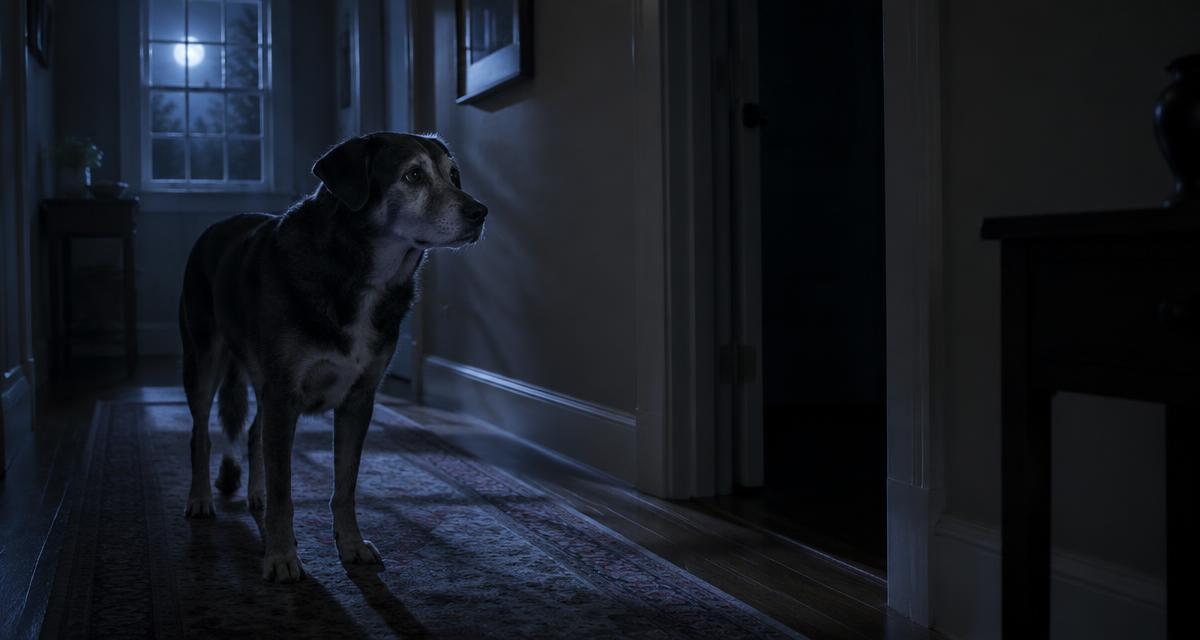
Sundowning in dogs: night-time pacing and confusion
A dog who is calm all day and unrecognizable after dark. Pacing, panting, barking at nothing, standing in a corner at two in the morning. Owners call it sundowning, borrowing the term from human dementia care — and it is one of the most common reasons a senior dog ends up at the vet. It sits within the wider picture of senior canine health, where sleep, comfort, and cognition all affect each other.
What sundowning looks like
Sleep-wake disruption is one of the six DISHAA categories veterinary behaviorists use when screening for canine cognitive dysfunction — and the one owners notice first.
- Settling all day, then becoming restless as the light goes
- Pacing a hallway or circling a room after dark
- Panting with no heat, exercise or obvious trigger
- Barking, whining or howling at nothing identifiable
- Standing in a corner or staring at a wall at night
- Wanting out, then standing at the door without going
- Waking repeatedly and seeming briefly unable to place the room
- Day and night effectively swapping around
It is not always cognitive
Veterinarians work through physical explanations before considering cognitive dysfunction, because several of them are far easier to treat. This list is here so you know what your vet will be thinking about — not so you can rule anything in or out yourself.
Pain, especially arthritis
Stiff on rising, reluctant on stairs, worse after a big day. Often the simplest explanation.
Vision loss
Fine in daylight, hesitant or bumping in dim light. Evening confusion may be a seeing problem.
Hearing loss
Startles when touched, no longer wakes to the door. Can look like confusion or anxiety.
Needing to toilet more
Night restlessness that ends once outside. Several medical conditions increase urination.
Medication timing or side effects
Restlessness that began near a prescription change. Only your vet should adjust anything.
Anxiety unrelated to age
New household changes, a move, a lost companion animal. Grief and disruption cost sleep too.
“A bad night is an anecdote. Twelve logged nights is evidence your vet can act on.”
What to record before the appointment
Night behavior is nearly impossible to describe accurately from memory, and it is exactly the detail a veterinarian needs. Two weeks of notes changes the conversation.
The clock
The time the restlessness starts, the time it ends, and when your dog finally settles. Sundowning has a shape you can write down.
The count
Number of wakings per night, and how many nights per week. A number tracks progression; "lately" does not.
The behavior
Pacing, panting, vocalizing, staring, seeking you out. Which one dominates tells your vet something different.
Thirty seconds of video
A short night-time clip shows a veterinarian in seconds what a paragraph struggles to convey.
The day before
How much activity, daylight, and rest preceded a bad night. Patterns show up over a fortnight.
What usually helps
Routine and environment only. We do not list medications, supplements or doses anywhere on this site — those belong to the veterinarian who knows your dog's other conditions.
Anchor the daytime
Daylight exposure and gentle activity during the day is the routine measure veterinary sources most consistently pair with steadier nights.
Make the last hour predictable
The same short walk, the same wind-down, the same bedtime. Older dogs lean heavily on a repeated sequence.
Light the route
A dim night light along the path to the water bowl or the door removes a lot of night-time confusion, especially for a dog whose sight is fading.
Simplify the floor
Clear the pacing route, block stairs, keep rugs flat. A safe lap of the house is better than a blocked one.
Sleep near, respond calmly
Being reachable often shortens an episode. Brisk correction usually lengthens it.
Take it to your vet
Sundowning is a reason for an appointment, not a thing to wait out. Management plans exist, and they include options we deliberately do not list here.
Where this sits in cognitive aging
Ordinary aging does change a dog's mind. Across 25,463 Dognition assessments, reasoning slides after about age eight (0.427 to 0.354 in the oldest dogs) while empathy keeps climbing to a peak of 56.1 around age 9. None of that normal trajectory includes a dog who cannot settle at night. Disrupted nights are a change worth investigating, not a stage to accept.
When is a dog considered a senior?
Veterinary life-stage guidelines define a senior dog as one in the last 25% of an estimated lifespan, and that estimate is set by breed and size — not by a birthday. So the same age means very different things to two different dogs.
Ages most often used for senior status, grouped by adult size.
| Size | Adult weight | Often senior at | Familiar breeds |
|---|---|---|---|
| Toy & small | Under 20 lb (9 kg) | About 8–11 years | Chihuahua, Dachshund, Pug, Toy Poodle, Yorkshire Terrier |
| Medium | 20–50 lb (9–23 kg) | About 8–10 years | Beagle, Cocker Spaniel, Border Collie, Bulldog |
| Large | 50–90 lb (23–41 kg) | About 8–9 years | Labrador Retriever, Golden Retriever, German Shepherd, Standard Poodle |
| Giant | Over 90 lb (41 kg) | About 6–7 years | Great Dane, Newfoundland, Mastiff, Irish Wolfhound |
Swipe the table sideways to see the familiar breeds in each size class.
The same birthday, two different life stages
Great Dane
May be treated as a senior at around 6 years old.
Labrador Retriever
On an average lifespan of 11–13 years, roughly senior at 8 or 9 years old.
Dachshund
May not be considered a senior until about 10 years old.
Chihuahua
At 9 years old, typically still less senior than a 9-year-old Great Dane.
These ranges come from published veterinary guidance and overlap between sources — one organization may call small breeds senior at 10–12 while another says 8–11. Treat them as a starting point. Whether your individual dog has reached their senior years, and what that means for their care, is a question for your own veterinarian.
Sources
- AAHA Canine Life Stage Guidelines — Creevy KE, et al. J Am Anim Hosp Assoc 2019;55:267–290Defines the senior stage as the last 25% of estimated lifespan, dependent on breed and size, and recommends at least twice-yearly exams for senior dogs.
- Banfield Pet Hospital — What age is a dog considered a senior?Size-based senior age bands: small under 20 lb, medium 20–50 lb, large 50–90 lb, giant over 90 lb.
- AKC — Is Your Dog a Senior Yet? Here's How to TellVeterinarian commentary on aging by breed and size, and the final-quarter-of-life-expectancy approach.
- PetMD — When Is a Dog Considered a Senior? (Morrison BJ, DVM)Size as the most accurate indicator of senior status, with small breeds around 10–12 years and large or giant breeds as early as 6–8.
- Cornell Riney Canine Health Center — Caring for Your Senior DogVeterinary guidance on senior dog care and why the seven-year rule of thumb is unreliable for individual dogs.
Frequently asked questions
- What is sundowning in dogs?
- Sundowning is the everyday name for restlessness, pacing, vocalizing and confusion that appears in the evening and overnight in some older dogs. The term is borrowed from human dementia care. In dogs it is most often discussed as part of canine cognitive dysfunction, but it is not a diagnosis on its own.
- Does sundowning always mean dementia?
- No. Pain, vision or hearing loss, needing to toilet more often, medication effects and ordinary anxiety all produce night-time restlessness. Veterinarians work through those first, which is why an exam matters before assuming cognitive dysfunction.
- At what age does sundowning start?
- There is no fixed age. It is reported in senior dogs, and what counts as senior varies with size and breed. What matters more than age is change: nights that are different from how your dog has always slept.
- How can I help my dog at night?
- Routine measures include daytime light and activity, a predictable wind-down, a dim night light, a clear and safe pacing route, and staying reachable so episodes stay short. Anything beyond routine and environment — diet, supplements, medication — should come from your own veterinarian.
- Should I wake my dog or let them pace?
- Most owners find that calm reassurance and a short escorted trip outside shortens an episode, while scolding lengthens it. If your dog seems distressed most nights, that frequency is itself information for your vet.
- When is a dog considered a senior?
- There is no single age. Veterinary guidelines define a senior dog as one in the last 25% of its estimated lifespan, and that estimate depends on breed and size. In practice that means small breeds (under 20 lb) are often considered senior at about 8–11 years, medium breeds (20–50 lb) at about 8–10 years, large breeds (50–90 lb) at about 8–9 years, and giant breeds (over 90 lb) as early as 6–7 years. Your own veterinarian can put a number on it for your dog, because they know the breed, body condition and health history behind the estimate.
- Why do small dogs become seniors later than large dogs?
- Size is the clearest predictor of how fast a dog ages: larger breeds have shorter average lifespans, so the final quarter of life arrives sooner. A 9-year-old Great Dane is usually much further into their senior years than a 9-year-old Chihuahua. Because small dogs live longer overall, their senior window starts later and can stretch into their early teens.
- Is a dog a senior at 7 years old?
- Seven is a useful reminder to start watching for change, not an official line. Veterinarians often use around seven years as the point to discuss twice-yearly exams and more regular bloodwork, but a seven-year-old Great Dane is already well into senior years while a seven-year-old Chihuahua is usually still middle-aged. The more reliable approach is to ask what lifespan is typical for your dog's breed and size, and treat the last quarter of that as senior.
- How do I know my dog has actually reached their senior years?
- Watch your dog, not the birthday card. The shift is usually gradual: a slower recovery after excitement, more stiffness after a rest, cloudier eyes, or a preference for routine over novelty. Veterinary guidelines recommend at least twice-yearly exams once a dog is senior, so asking your veterinarian at the next visit whether your dog has reached that stage — and what exam schedule fits them — is the clearest answer you can get.
- Does senior-age guidance apply to mixed-breed dogs?
- Yes, and for a mixed-breed dog size is the better guide than breed. Use your dog's adult weight to pick a size class — under 20 lb, 20–50 lb, 50–90 lb, or over 90 lb — and read the matching range. If your dog's adult weight is uncertain, or they sit between two classes, your veterinarian can estimate their likely lifespan and tell you when to expect senior changes.
Sources
- Cornell Riney Canine Health Center — Cognitive dysfunction syndromeClinical reference on disrupted sleep-wake cycles in senior dogs and diagnosis by exclusion.
- American Veterinary Medical Association — Senior pet careWhen a behavior change in an older pet warrants a veterinary exam.
- Landsberg, Nichol & Araujo (2012), Veterinary Clinics of North AmericaReview describing the DISHAA categories, including sleep-wake disruption.
Always confirm anything health-related with your own veterinarian.