How to Potty Train a Dog: The Complete Science-Based Guide
Potty training isn't complicated — but it is unforgiving of inconsistency. Nearly every "my dog won't house-train" conversation traces back to the same three issues: too much freedom too early, a schedule that drifts, or rewards delivered too late to matter.
This guide gives you the same four-pillar protocol that veterinary behaviorists and Dr. Brian Hare's team recommend, plus a first-day schedule you can copy, an age-based bladder chart, and evidence-based fixes for the six most common problems.
The four pillars of potty training
Skip any one of these and training slows down or stalls. Get all four right and most dogs are reliable within 4–6 weeks.
Schedule
Take your dog out on a predictable cadence: first thing in the morning, after every meal, after every nap, after every play session, and last thing before bed. Puppies under 4 months need out every 45–60 minutes when awake.
Supervision
An un-potty-trained dog is either on a leash tethered to you, in a crate or playpen, or actively watched. Zero unsupervised roaming. Every accident that happens indoors is one your dog learns is normal.
Reward
Pay in the moment your dog finishes eliminating outside — three small treats and enthusiastic praise while they're still in the spot. Waiting until you're back inside teaches 'coming inside pays,' not 'peeing outside pays.'
Cleanup
Clean every accident with an enzymatic cleaner (not ammonia — it smells like urine and invites repeat marking). Any lingering scent tells your dog this is the bathroom.
How long can a dog actually hold it?
Bladder capacity roughly follows the rule "age in months + 1 hour," capped at about 8 hours for healthy adults. Small breeds and seniors need more frequent breaks.
| Age | Realistic hold | Notes |
|---|---|---|
| 8 weeks | About 2 hours | Every 45–60 min when awake. |
| 10 weeks | About 3 hours | Overnight may still need one break. |
| 12 weeks | 3–4 hours | Most puppies sleep through the night. |
| 4 months | 4 hours | Add 1 hour per month of age as a rule of thumb. |
| 6 months | 5–6 hours | Still not a full workday — arrange a midday break. |
| 1 year+ | 6–8 hours | Never make holding it a routine — it's a health risk. |
Copy-and-paste Day 1 schedule
A sample schedule for an 8–12 week-old puppy. Adult dogs use the same framework with fewer potty breaks.
- 6:30 AMStraight from crate to potty spot on leash. Reward on completion.
- 7:00 AMBreakfast. Water available for 15 minutes.
- 7:30 AMPotty break. Then 30 minutes of play or short training.
- 8:00 AMNap in crate (60–90 min for puppies).
- 9:30 AMPotty break immediately on waking. Play + supervised free time.
- 11:00 AMPotty. Lunch (for puppies under 4 months). Rest.
- 1:00 PMPotty. Training session, then nap.
- 3:00 PMPotty. Chew or enrichment toy in playpen.
- 5:00 PMPotty. Dinner. Water for 15 minutes.
- 6:30 PMPotty. Family time (tethered or in pen).
- 8:30 PMPotty. Wind-down and last drink.
- 10:30 PMFinal potty. Into crate for the night.
- 2:00–3:00 AMOne quiet overnight break for puppies under 12 weeks.
Why the crate is a potty-training superpower
Dogs are hard-wired to keep their sleeping area clean. A correctly-sized crate becomes a temporary bladder-training tool — not a punishment, and never a full-day storage unit. Follow these six steps to introduce it well.
- 1Pick a crate just big enough for your dog to stand, turn, and lie down. Anything larger becomes a bedroom-plus-bathroom.
- 2Feed every meal inside the crate with the door open for 3 days. The crate becomes 'the food room,' not 'the alone room.'
- 3Close the door for 30 seconds while your dog eats, then open before they finish. Build to 5 minutes.
- 4Toss a frozen stuffed toy in and close the door. Leave the room for 2, then 5, then 15 minutes.
- 5Never let your dog out while whining. Wait for 3 seconds of quiet, then open. Whining that pays becomes barking that pays.
- 6Move the crate to your bedroom for the first two weeks so nighttime potty cries are audible before they become accidents.
Read the results: the Bristol Stool Scale
Potty training isn't just where your puppy goes — it's what comes out. Stool quality is one of the fastest, cheapest health signals you have, and it directly affects how predictable your schedule can be. Loose stools mean more accidents and shorter hold times; hard, dry stools can mean dehydration or not enough fibre.
We use the Bristol Stool Scale inside the CanineQ app analysis so owners can log a quick daily check and spot problems before they become vet visits. Aim for Type 3 or Type 4 — a formed, soft sausage shape. Anything at the ends of the scale for more than 24–48 hours is worth a call to your vet.
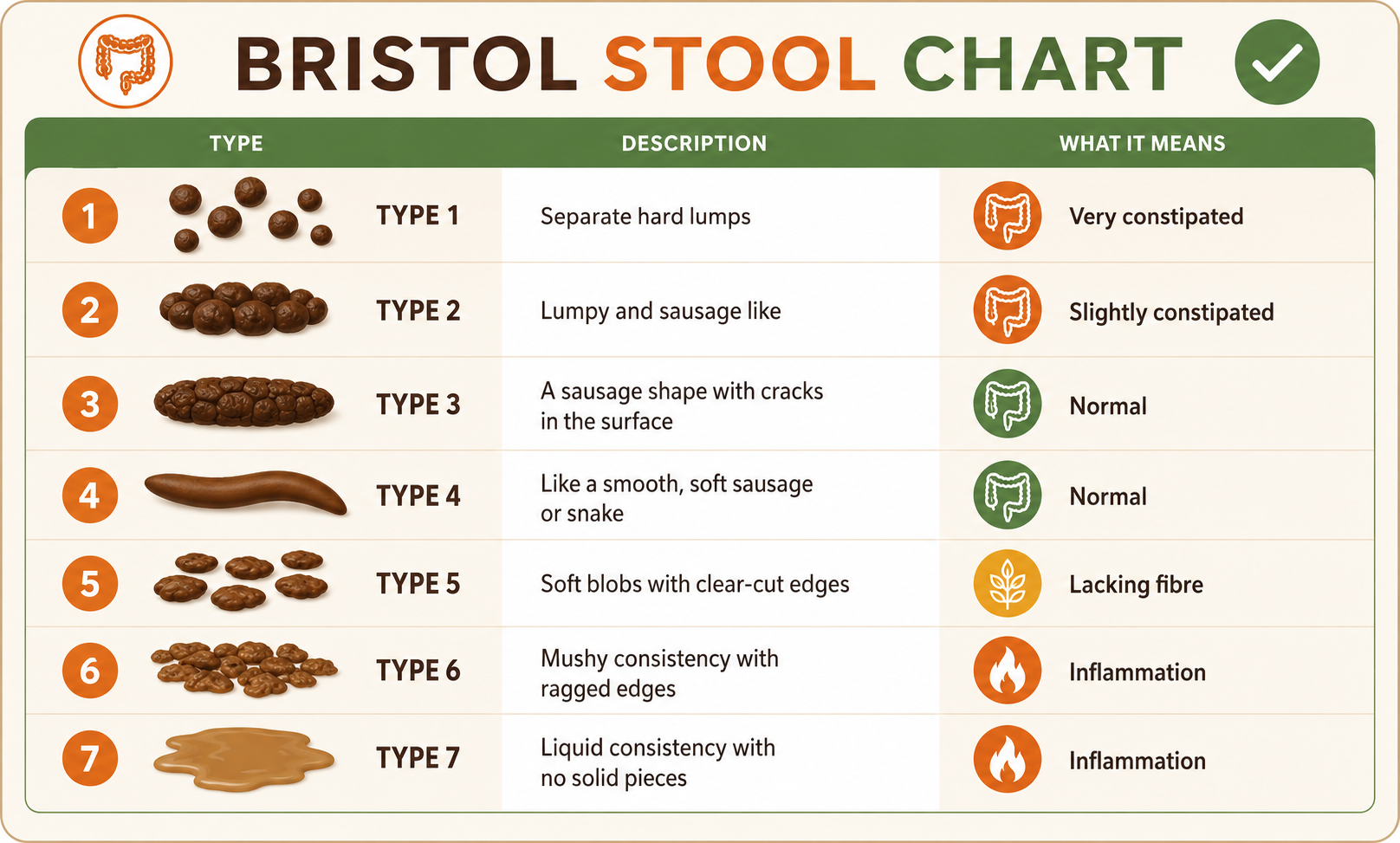
Quick reference
- Type 1–2: constipated — add water, fibre, and movement.
- Type 3–4: normal — your schedule and diet are working.
- Type 5: lacking fibre — check food quality and portion size.
- Type 6–7: inflammation or GI upset — call your vet if it lasts >24h, sooner for puppies.
How to handle an accident
- Caught in the act: a calm "ah-ah!" is enough to interrupt. Scoop up and get outside immediately. Reward heavily if they finish outside.
- Found after the fact: clean silently with an enzymatic cleaner. Never rub your dog's nose in it, never scold. This is a supervision failure, not a dog failure.
- Log it. Write down time, location, and what happened in the previous 30 minutes. Patterns emerge fast — usually a missed break after a nap or meal.
Fixing the five most common problems
My puppy pees the second we come back inside.
You came in too soon. Stay outside for a full 5 minutes after the first pee — many puppies need two rounds. Also make sure the outside trip is boring: on leash, same spot, no play until they've finished. Play is the reward that comes after.
My adult rescue dog isn't house-trained.
Start from scratch as if they were 8 weeks old. Many rescues learned to eliminate on concrete or in a kennel, so grass or your yard is a new surface. Give it 30 days of tight scheduling and supervision before deciding whether medical or behavior evaluation is needed.
My dog was trained, then started peeing indoors again.
Regressions almost always have a cause: a UTI (rule out with a vet visit first), a schedule change, a stressor (new baby, move, houseguest), or a punishment that made your dog afraid to eliminate in front of you. Reset to Week 1 supervision and add environmental predictability.
My dog only goes on rugs or carpet.
Soft absorbent surfaces feel like grass to a dog trained on pads. Remove access to those rooms with baby gates for 30 days and reward every successful outdoor trip heavily. Reintroduce carpeted rooms only under active supervision.
My dog holds it outside for an hour, then pees inside.
Either the outdoor environment is too stimulating (they're distracted) or too scary (they can't relax). Try a different spot, shorten the outing to 5 quiet minutes, and don't head back inside until they've gone — even if it means multiple attempts.
Frequently asked questions
- How long does it take to potty train a dog?
- Most puppies are reliably house-trained by 4–6 months with consistent effort, though occasional accidents are normal through 12 months. Adult dogs and rescues typically take 4–8 weeks. Success depends far more on consistency than on breed, age, or intelligence.
- Should I use puppy pads?
- Only if you have to — for example, an apartment where an outdoor trip takes 10 minutes. Pads teach 'inside is a legitimate bathroom,' which is a habit you'll have to un-teach later. If outdoor access is available, skip pads and take your puppy out on schedule.
- How do I potty train a puppy in an apartment?
- Establish one indoor pad spot AND an outdoor spot from day one. Reward outdoor eliminations 3x more heavily than pad eliminations. As the puppy matures (12–16 weeks), gradually move the pad closer to the door, then just outside the door, then remove it.
- Should I punish my dog for accidents?
- No. Punishment after the fact teaches only that you are unpredictable — dogs cannot connect a scolding to an event more than a few seconds old. Punishment during an accident teaches your dog to hide when they need to go, which makes training harder. Clean it up, tighten your schedule, and move on.
- How often should an adult dog go out?
- Three to five times a day for adult dogs — morning, midday if possible, evening, and before bed. Senior dogs and small breeds may need more. Adult dogs shouldn't be forced to hold urine longer than 6–8 hours; regular long holds increase UTI and bladder-stone risk.
- When should I see a vet about potty accidents?
- Any sudden regression in a previously house-trained dog warrants a vet visit to rule out UTI, bladder stones, diabetes, kidney disease, or cognitive dysfunction in seniors. Frequent small puddles, blood in urine, straining, or excessive water intake are all reasons to book an appointment right away.
- Does my dog's cognitive style affect how fast they house-train?
- Yes. High-memory dogs generalize the routine in fewer repetitions; high-empathy dogs read your tone and often perform better with gentle praise than food; high-cunning dogs need tighter management because they'll sneak off to a rug when unsupervised. Dognition's assessment shows you which profile you're working with so you can adapt.
Understand how your dog learns
Potty training goes faster when the plan fits your dog's mind. Dognition's science-based assessment reveals your dog's cognitive profile across five dimensions — so you know whether to lean on memory, empathy, or tighter management.
Related reading: How to Train a Puppy · How to Train a Dog · What Is Puppy Kindergarten?
More from potty training
Predictable schedules, active supervision, and immediate rewards — the three levers that actually move the needle.