Is My Dog Limping? How to Spot Subtle Gait Changes Early
Most dog owners notice a limp only when it is dramatic — a held-up paw, a yelp, a refusal to jump on the couch. But by the time a limp is that obvious, the underlying problem has usually been building for weeks or months. The earliest signs of joint trouble, soft tissue strain, and hip dysplasia are almost invisible to the human eye. If you have ever wondered is my dog limping but no pain when touched, the answer is often yes — subtly — and the video on your phone can prove it.
What a subtle limp actually looks like
Veterinary orthopedic specialists describe early gait changes as "micro-lameness." Instead of a clear limp, you see:
- Asymmetric weight distribution — the dog stands with one paw slightly forward or unloaded when at rest.
- A head bob at the trot — the head drops slightly when the sound leg hits the ground and lifts when the sore leg takes weight.
- A shortened stride on one side — the sore leg spends less time bearing weight, so it swings forward and pushes off faster.
- Compensatory movements — a subtle roll of the pelvis, a tucked tail, or a shift of the shoulder muscles as the dog protects the affected joint.
- Slower to sit or rise, or a "sit-scoot" where the back legs slide out to one side.
These signals are consistent across a huge range of conditions — hip dysplasia, cruciate ligament partial tears, elbow disease, iliopsoas strains, spinal disc issues. The pattern of asymmetry matters more than any single moment.
Why human eyes miss it
A dog trots at roughly two footfalls per second. Each stride contains hundreds of small biomechanical cues, and the difference between a healthy stride and an early lame stride can be less than 10% in stance time. Human observers reliably detect lameness at around grade 2 out of 5 on the standard orthopedic scale — grade 1 is essentially invisible without slow-motion video or a pressure-sensitive treadmill. That is why so many dogs are diagnosed with cruciate ligament disease or hip dysplasia "suddenly," when in fact the imaging shows chronic changes that have been developing for a long time.
How CanineQ catches what you can't
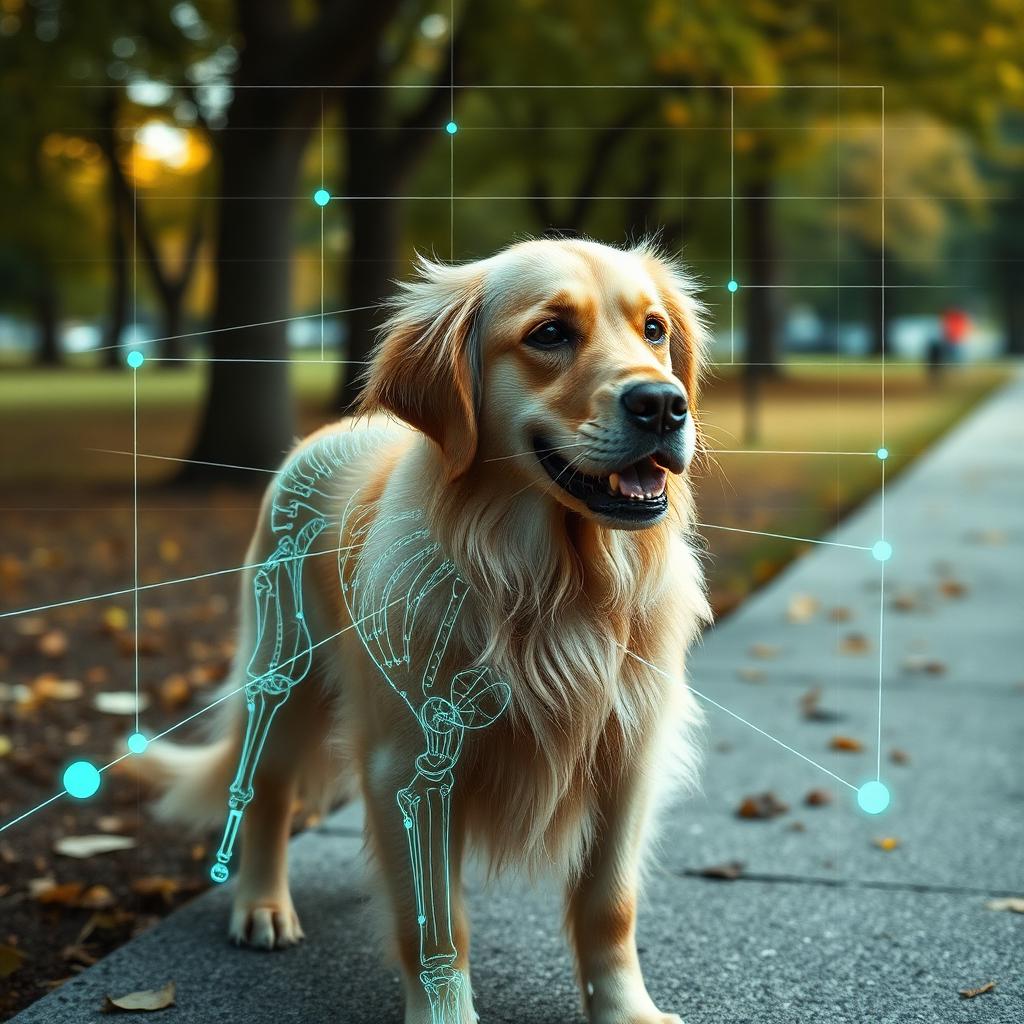
The single most useful thing you can do for your dog's musculoskeletal health is film a 10-second gait video every few weeks. CanineQ's AI video analysis uses frame-accurate computer vision to compare left-side and right-side stance times, stride lengths, and head-bob amplitude. It flags asymmetries a human observer would need a treadmill and a stopwatch to see, and it tracks those numbers over time so a slow drift is visible as a trend, not a guess.
The workflow is deliberately simple: film your dog walking away from you and back toward you on a flat surface at a normal pace. The AI does the rest. You get a plain-language readout — "left front stride is 8% shorter than right" — and a history you can share with your veterinarian.
Try this at home: the 10-second gait check
Even without an app, you can do a first-pass check today. Film your dog trotting on a level, non-slippery surface, both away from and toward the camera. Watch the video at half speed on your phone. Look for a head bob at the trot, a difference in how long each front paw spends on the ground, and whether the hips rise evenly with each stride. Compare to a video from a month ago if you have one. If anything looks off, take the videos to your vet — they will thank you for the footage.
When to skip the phone and call your vet immediately
AI video analysis is for the quiet, chronic signals. It is not a substitute for a veterinarian when there is:
- A sudden non-weight-bearing lameness after a fall or a hard play session
- Visible swelling, heat, or an open wound
- Yelping or crying when the leg is touched or moved
- Refusal to stand or walk at all
Those are emergencies. Everything else — the intermittent morning stiffness, the slightly slower jump onto the bed, the almost-imperceptible head bob — is exactly the territory where early video tracking changes outcomes.
Why early matters
Joint disease is progressive. Every week a dog compensates for a sore hip, the surrounding muscles remodel, the opposite limb takes on extra load, and the spine adapts. Early detection means earlier weight management, targeted physical therapy, joint-supportive nutrition, and — where appropriate — surgical options that are far less invasive than what a later-stage case requires. The 10-second video you film today may add years of good mobility to your dog's life.
Ready to check your dog's gait? Upload a 10-second gait video to CanineQ and let frame-accurate computer vision flag uneven strides. Curious how the AI works? See how CanineQ's video analysis was built.
Building good habits from day one starts with puppy kindergarten.