More than meets the eye…
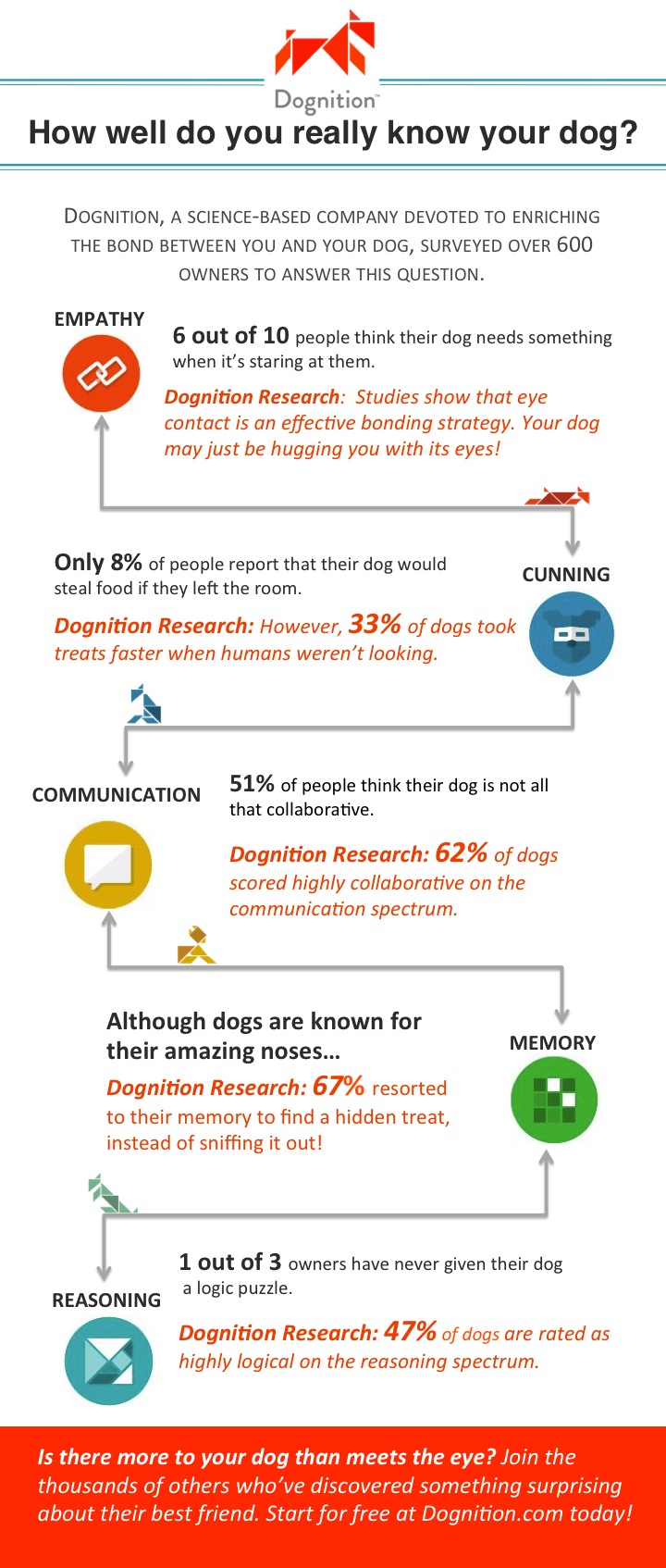
After months or years of spending time with our dogs, we begin to feel that we know everything about them. Dognition has collected some surprising facts. Read on to find out the answer to how well you really know your dog.
What owners tend to miss
When we asked thousands of Dognition owners to predict how their dog would perform on our games before actually running them, a clear pattern emerged: most people were confident about the wrong things and modest about the right ones. Owners routinely underestimated their dog’s empathy — the ability to read human emotion and match it — and just as routinely overestimated memory. “She remembers where I hid the toy from last week” turns out, more often than not, to be “she smells where you hid the toy from last week.” Two very different cognitive skills.
Communication is the biggest blind spot. Dogs are constantly reading our eye direction, our body angle, our tone, and our timing — sometimes before we’ve consciously decided what we’re about to do. Most owners have no idea how sensitive their dog is to those signals until they see it demonstrated in a controlled game.
Why individual differences matter
The single most surprising Dognition finding is that variation within a breed is often larger than variation between breeds. Two golden retrievers from the same litter can score in completely different profiles — one a Charmer, one an Ace — and the reason is not training. It’s cognitive style. Some dogs default to reading you; others default to solving problems on their own. Neither is smarter. They’re different kinds of smart.
Once you know which kind of thinker your dog is, small adjustments to how you cue, reward, and play together make everyday life dramatically easier. That is what the assessment is really for — not a score, but a map.
Curious what your dog’s map looks like? Play the Dognition games and see which of the nine profiles fits your best friend.