How Dognition Built The First Longitudinal Canine Cognitive Monitoring Platform
For more than a decade, Dognition has translated university-level canine cognition research into something any dog owner can use at home. It started with a simple idea: instead of guessing how smart your dog is, measure it across the dimensions that actually matter — empathy, communication, cunning, memory, and reasoning. That work led to Continuous Cognitive Monitoring (CCM), the system that turns a one-time assessment into a living cognitive health record.
That idea became the Dognition Assessment, a set of science-based games developed from the work of Dr. Brian Hare and Vanessa Woods at the Duke Canine Cognition Center, authors of The Genius of Dogs and Puppy Kindergarten. Millions of dogs have played those games. But a single profile, no matter how precise, is still a photograph of one moment in time.
What happens next is what Dognition has spent the last few years building: a way to turn that single photograph into a moving picture of your dog's mind.
From snapshot to living record
Most health information about dogs arrives late. A limp, a change in appetite, a withdrawn mood — these are the signals owners notice after something has already shifted. By then, the story is harder to reconstruct and the baseline is harder to find.
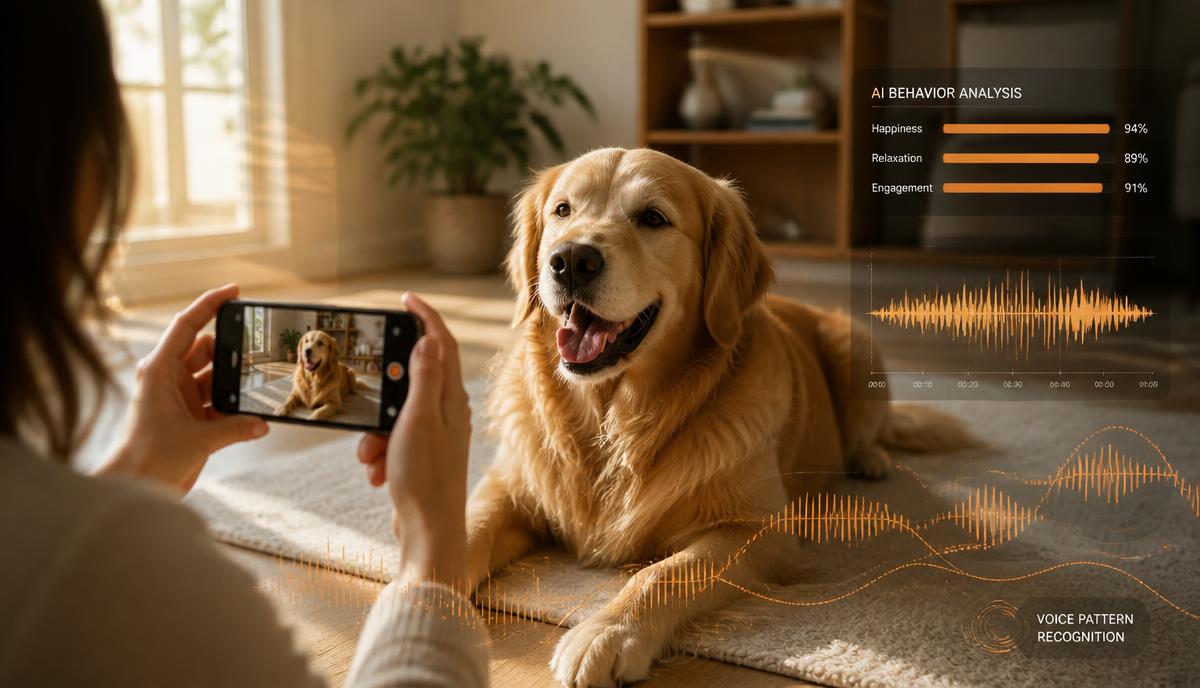
Continuous Cognitive Monitoring (CCM) changes the order of events. It starts with the Dognition Assessment as a cognitive baseline, then adds ordinary videos you upload over time. Dognition's AI reads behavior and cognition from that footage and layers each session on top of your dog's original profile. When something moves against the baseline, CCM surfaces it in plain language.
What is Continuous Cognitive Monitoring? →
How deep video analysis makes CCM possible
The technical leap is video. A single short clip of your dog contains far more signal than most owners can log reliably: ear position, tail carriage, gait, gaze direction, response latency, repetitive behaviors, and dozens of other micro-signals that flicker in and out of view faster than human memory can capture.
The CanineQ app runs this analysis. You record a moment — a meal, a vet visit, a walk, a check-in — and the model reads what is happening in the same five dimensions the original assessment measured. Each video becomes a data point. Over months and years, those points trace a curve.
This is not about replacing veterinarians or trainers. It is about giving them a record they do not currently have: a longitudinal view of how your dog's cognition and behavior have moved, with timestamps and context.
DognitionGPT: making the signal readable
Raw behavior data is only useful if the person reading it understands what it means. That is where DognitionGPT comes in. Built on the same canine cognition science that powers the assessment, it translates AI findings into explanations you can act on.
Instead of a dashboard full of numbers, you get answers to practical questions: "This looks different from last month — should I mention it to my vet?" "Is this change part of normal aging, or does it stand out against my dog's baseline?" "What kind of enrichment matches what CCM is seeing right now?"
Why longitudinal matters for dogs
Dogs change quickly. A puppy becomes an adult in under two years. A senior dog can show cognitive shifts in a matter of months. Without a baseline, those changes are easy to attribute to personality or mood. With a baseline, they become measurable.
CCM is designed to catch the kind of changes owners already sense but struggle to describe: a usually communicative dog stopping their gaze games, a high-memory dog missing routines, a social dog withdrawing from interaction. Against a known baseline, those observations carry weight.
The platform draws on a normative dataset of more than 122,000 dogs, so the comparisons are not arbitrary — they are grounded in the same research sample that has shaped Dognition's profiles and data center from the beginning.
What CCM tracks — and what it does not
CCM tracks the five cognitive dimensions measured by the Dognition Assessment, plus the behavioral signals visible in everyday video. It looks for meaningful movement against your dog's own history. It does not diagnose disease, predict lifespan, or replace clinical exams.
Its job is to organize and summarize the signals your dog is already sending, so conversations with your vet or trainer start with data instead of hunches. Think of it as a cognitive health record, not a medical device.
You can read the full breakdown of what CCM surfaces, how it fits with veterinary care, and where it connects across the Dognition platform on the Continuous Cognitive Monitoring page.
The larger goal
Dognition was never meant to be a one-time test. The assessment was always the first chapter: a way to give every dog a cognitive identity. CCM is the rest of the book — the ongoing story of how that identity changes, what it means for health and behavior, and how early information can lead to better care.
That is the platform Dognition is building now: an AI-powered learning system that helps dogs stay understood for their whole lives, from puppy to senior.